

Most Manufacturing Websites Don’t Fail Technically - They Fail Commercially.
Your website may be live, functional, and professionally built — but if it doesn’t actively support your sales process, qualify serious buyers, and reduce supplier risk in the eyes of industrial decision-makers, it is not contributing to revenue.
It is simply existing.
We Have a Website. So We’re Covered.
For many manufacturing companies, the website is treated as a completed task. It was built, approved, and published. It lists products, certifications, infrastructure, and contact details. Internally, that creates a sense of closure — digital presence is handled.
But presence is not performance.
In B2B manufacturing, the website is rarely treated as a commercial asset tied directly to sales outcomes. It becomes informational instead of strategic. Static instead of structured.
That misunderstanding creates invisible friction in the buyer journey.
How It’s Commonly Treated:
- A credibility checkbox
- A digital company brochure
- An online version of a PDF profile
- A marketing requirement
What It Should Function As:
- A structured sales support system
- A buyer risk-reduction tool
- A qualification layer before sales engagement
- A revenue-aligned commercial asset
Industrial buyers do not visit your website to browse. They visit to reduce risk and shortlist suppliers. If your website does not make that decision easier, they move on — without telling you why.
The Real Business Cost of a Weak Website
A weak manufacturing website does not usually fail loudly.
- It does not crash.
- It does not break.
- It does not generate complaints.
It simply underperforms — quietly.
And that quiet underperformance creates measurable business friction across sales, marketing, and operations.

Diluted Sales Capacity
When the website does not pre-qualify buyers, your sales team becomes the filter. Time is spent handling poor-fit inquiries instead of advancing serious opportunities.
Unpredictable Lead Quality
Without structured positioning, inquiries vary widely in relevance. Conversion rates become inconsistent, making forecasting and planning difficult.
Channel Dependency
Growth remains dependent on exhibitions, referrals, and outbound efforts because inbound inquiries lack structure and qualification.
It’s Not a Traffic Problem. It’s a Structural Alignment Problem.
Most manufacturing websites are built around company information.
But industrial buyers do not evaluate suppliers based on information alone.
They evaluate based on:
- Risk reduction
- Capability depth
- Industry relevance
- Commercial confidence
When a website is structured around “About Us” instead of buyer evaluation logic, friction is inevitable.
The real issue is this:
Your website is structured around what you want to say.
Not around how buyers decide.
That gap creates:
- Generic messaging
- Broad positioning
- Unqualified inquiries
- Sales dependency for clarification
This is not a design flaw.
It is an architectural flaw.
01 01
Company-Centric Structure
Pages organized around:
- About
- Products
- Certificates
- Gallery
Instead of:
- Industries served
- Application depth
- Technical qualification pathways
- Clear buying triggers
02 02
Information Without Evaluation
Information exists.
But it does not help buyers:
- Compare you
- Shortlist you
- Trust you technically
- Understand fit
It answers “who you are.”
Not “why you are right for them.”
03 03
No Built-In Qualification Logic
Every serious B2B website should:
- Filter poor-fit inquiries
- Attract technically aligned buyers
- Pre-frame pricing expectations
- Reduce repetitive sales explanations
If it doesn’t, sales becomes the filter.
And that’s expensive.
What a Commercially Structured Manufacturing Website Actually Looks Like
If industrial buyers evaluate suppliers based on risk reduction, capability depth, and commercial confidence, then your website must be structured around that evaluation logic.
Not around company information.
Not around design trends.
Not around traffic generation alone.
A manufacturing website must function as a structured commercial system.
Core Framework
We define it as five architectural layers.
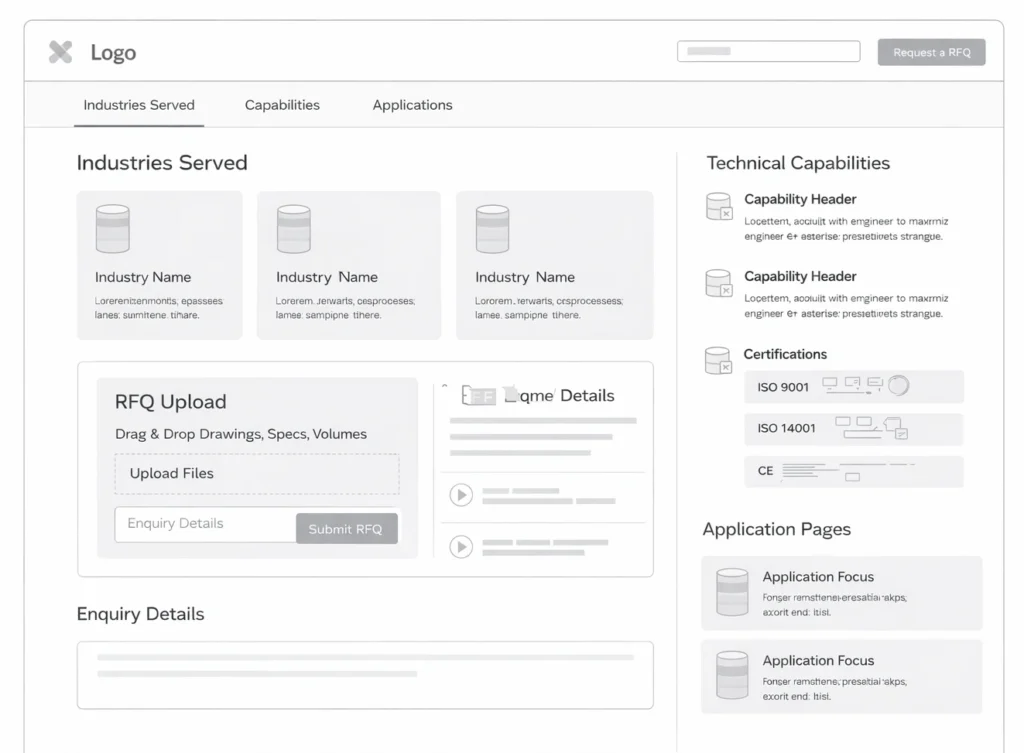
01 01
Industry & Application Positioning
Instead of saying:
“We manufacture precision components.”
You define clearly:
- Industries served
- Application environments
- Use-case specificity
- Regulatory or compliance context
The buyer should know within seconds:
“Is this supplier built for my industry?”
02 02
Technical Depth & Capability Clarity
A serious manufacturing website must:
- Show process capabilities
- Production capacity
- Tolerance ranges
- Quality control systems
- Certifications in context
Capabilities are presented as proof — not inventory.
But as proof of operational reliability.
This reduces perceived supplier risk.
03 03
Built-In Qualification Logic
The website should:
- Pre-qualify inquiry types
- Clarify minimum order logic
- Frame lead time expectations
- Set scope boundaries
So sales doesn’t become the filter.
The system filters first.
04 04
Think Long-Term
Beyond technical capability, buyers look for:
- Case applications
- Client industries
- Export footprint
- Infrastructure transparency
Not decorative logos. Operational credibility.
Confidence signals tied to real operational scale.
05 05
Sales Enablement & Conversion Architecture
A structured website must:
- Structured inquiry pathways
- Technical download gating
- Multi-step qualification routing
Precision increases authority.
06 06
Commercial Alignment Outcome
- Qualified conversations
- Reduced sales friction
- Predictable conversion patterns
- Revenue-aligned website behavior
To understand how this framework translates into real implementation detail, see our breakdown of the structured manufacturing website build process.
This Engagement Is Not For Every Manufacturer
We are not a fit if:
- You are looking for a fast brochure-style website.
- Your primary decision factor is lowest cost.
- Your internal sales process is undefined.
- You are not willing to map how RFQs move inside your organization.
- You expect traffic alone to fix conversion issues.
This work is designed for manufacturers who want structured commercial infrastructure — not cosmetic upgrades.
It requires clarity, internal collaboration, and operational discipline.
If your objective is predictable enquiry quality and stronger sales alignment, we should talk.
If not, a conventional website project will likely be more suitable.
How We Implement Commercial Website Infrastructure
A manufacturing website is a system — not a design project.
Phase Phase
01 01
Sales & Process Mapping
We begin by understanding how enquiries move inside your organization.
- How RFQs are received and evaluated
- Sales-to-engineering handoffs
- Commercial approval loops
- Current conversion gaps
- Internal bottlenecks
This stage identifies where digital structure must align with operational reality.
Phase Phase
02 02
Commercial Architecture Design
We redesign your website around how industrial buyers evaluate suppliers.
- Industry and application structuring
- Capability positioning
- Technical credibility layers
- RFQ qualification logic
- Conversion pathway design
The objective is commercial clarity — not visual redesign.
Phase Phase
03 03
RFQ & Qualification Engine Setup
We build structured enquiry systems that reduce internal friction.
- Multi-field RFQ forms
- Drawing and document upload logic
- Automated routing rules
- CRM field mapping
- Lead classification framework
This ensures enquiries enter your organization in usable format.
Phase Phase
04 04
Sales Workflow Alignment
Digital infrastructure must connect to pipeline visibility.
- Lead stage definition
- Qualification categories
- Reporting structure
- Accountability checkpoints
- Conversion tracking setup
This converts your website from lead generator into measurable sales system.
Phase Phase
05 05
Deployment & Validation
Before handover, the system is tested internally.
- Form and routing validation
- CRM sync testing
- Tracking verification
- Internal team walkthrough
- Commercial readiness check
Only after operational validation is the system considered complete.
If you are unsure where your current website stands structurally, a structured commercial review can identify specific gaps.
Structural Shift in Practice
Structured growth requires structural thinking.
Before Structural Alignment
- Generic contact form
- No RFQ classification
- No drawing upload logic
- Sales manually filters incomplete enquiries
- No visibility into enquiry-to-order conversion
Enquiries exist. Structure does not.
After Architecture Implementation
- Multi-field RFQ capture with volume and application context
- Drawing and specification upload integration
- Automated internal routing to relevant stakeholders
- CRM stage mapping for pipeline visibility
- Defined qualification checkpoints before quotation
Enquiries enter in usable format.
Sales and engineering operate with clarity.
Measurable Commercial Impact
When structure is aligned with your sales and operations, visibility improves across the system — not just at enquiry level.
RFQ-to-Order Visibility
A structured enquiry system allows you to see how many qualified RFQs enter your pipeline and how many convert into purchase orders. Instead of relying on assumptions, management can clearly see where enquiries stall, where conversion drops, and where commercial follow-up requires attention.
Reduced Unqualified Enquiries
When RFQs are captured with defined qualification logic, incomplete or non-viable enquiries reduce significantly. Your team spends less time filtering noise and more time evaluating commercially realistic opportunities. This reduces unnecessary internal review time and protects engineering bandwidth.
Faster Technical Evaluation
Enquiries submitted with specifications, volumes, application context, and documentation reduce internal back-and-forth. Engineering review cycles become shorter and decision-making becomes clearer. This minimizes repeated clarification cycles and shortens internal approval timelines.
Sales Accountability
When lead stages are defined and tracked, response delays and bottlenecks become visible. Sales performance shifts from reactive follow-ups to measurable pipeline management. Pipeline visibility creates measurable response expectations across the sales team.
Lower Channel Dependence
A structured commercial website reduces over-reliance on paid traffic or trade events for enquiry generation. Inbound activity becomes more predictable and system-driven.
Improved Forecasting Stability
With clearer enquiry quality and conversion tracking, management gains better visibility into revenue behaviour. This supports more stable production planning and working capital management.
Structured visibility becomes even more powerful when aligned with long-term search strategy for industrial buyers.
Engagement Structure
This is a structured commercial infrastructure engagement — not an open-ended design project.
Typical Timeline
Implementation typically spans 8–12 weeks, depending on internal responsiveness and process clarity.
Internal Involvement Required
Sales and operational stakeholders must participate during the mapping and validation stages. Commercial structure cannot be built in isolation from internal workflows.
Defined Review Stages
Work progresses through fixed stages with structured review checkpoints. Feedback is consolidated within agreed windows to maintain timeline discipline.
Client Responsiveness Impacts Delivery
Project continuity depends on timely input and approvals. Extended delays pause the engagement timeline.
Designed for Structured Manufacturers
This engagement is intended for B2B manufacturers seeking long-term commercial alignment — not short-term website refreshes.
Frequently Asked Questions
Manufacturers evaluating structured commercial infrastructure typically ask operational and implementation-related questions. The following address common decision considerations.
If Your Website Generates Enquiries But Not Predictable Orders
It Is Time to Review the Structure.
We conduct structured commercial reviews for B2B manufacturers seeking better RFQ quality, clearer pipeline visibility, and stronger sales alignment.
This is not a generic consultation call.
It is a structured evaluation of your current digital and sales architecture.