



What Happens Before a Manufacturing RFQ Is Sent
If you’re not receiving RFQs, you’re likely being eliminated — not ignored.
In industrial markets, buyers rarely tell suppliers they were screened out. They simply move forward with someone else.
Most manufacturers assume low enquiry volume is a traffic problem.
It usually isn’t.
It’s a shortlisting failure.
Industrial buyers evaluate suppliers online long before initiating contact. By the time your sales team receives an enquiry, internal validation has already happened.
This evaluation typically happens during the consideration and shortlisting stages of the Manufacturing Buyer Journey.
If your website does not support that validation process, you don’t just lose leads.
You lose credibility.
The Real Bottleneck: The Real Bottleneck:
Evaluation, Not Visibility
Many manufacturers invest in:
- SEO
- Trade portals
- Exhibitions
- Outbound sales
Visibility improves.
But enquiries remain inconsistent.
Even well-executed SEO for Manufacturing Businesses cannot compensate for structural evaluation gaps.
Because industrial buying is not awareness-driven.
It is risk-managed.
When a sourcing manager discovers your company, your website becomes the internal reference document shared with:
- Procurement
- Engineering
- Quality control
- Sometimes leadership
Industrial purchasing decisions are rarely made by one individual. Research on B2B industrial buying behavior shows that supplier validation typically involves multiple stakeholders reviewing technical, operational, and risk criteria before engagement.
Your website is no longer marketing collateral. It becomes a supplier evaluation infrastructure. If it fails that role, you are silently removed from consideration.
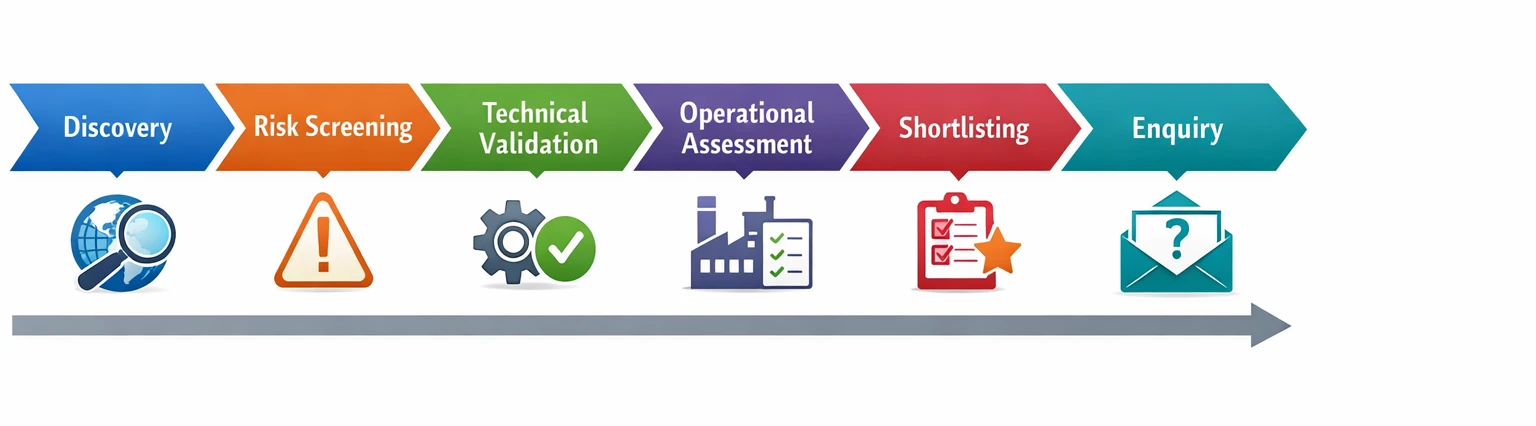
Phase 1 Phase 1
Rapid Risk Screening
The first evaluation phase takes minutes.
Buyers scan for structural clarity.
They ask:
- Does this supplier look real?
- Do they look structured?
- Do they appear capable of handling our requirement?
This is not emotional judgment. It is operational filtering.
Procurement risk management standards emphasize supplier transparency during early-stage evaluation.
For example:
A precision machining company that does not list tolerance capability (±0.01mm vs ±0.05mm) creates uncertainty.
A fabrication company that does not mention maximum sheet thickness or material grades forces guesswork.
An OEM supplier without visible compliance standards signals immaturity.
When buyers cannot confirm capability quickly, they reduce risk by eliminating the supplier.
No conversation required.
Phase 2 Phase 2
Technical Capability Validation
If a supplier passes the initial scan, the evaluation deepens.
Now buyers look for proof of control.
They assess:
- Machinery type and capacity
- Production throughput
- Inspection processes
- Testing methods
- Material traceability
- Quality documentation systems
International compliance frameworks, such as ISO supplier qualification requirements, reinforce structured capability validation.
Vague claims such as “High Quality Manufacturing” carry no weight.
Specificity does.
“CNC machining with 5-axis capability, 800mm travel, ±0.01mm tolerance, CMM inspection” communicates control.
Control reduces risk.
And risk reduction increases shortlisting probability.
Phase 3 Phase 3
Operational Maturity Assessment
Capability alone is not enough.
Industrial buyers look for operational discipline.
They evaluate whether your organization appears process-driven.
Signals include:
- Structured product categorization
- Logical navigation
- Defined industries served
- Documented quality systems
- Clear workflow descriptions
- Real facility imagery (not stock photos)
A chaotic website suggests internal disorganization.
In supply chains, disorganization equals instability.
Even subconsciously, buyers prefer suppliers that appear structured.
Structure implies predictability.
Predictability reduces supply risk.
Phase 4 Phase 4
Stability & Long-Term Viability
Procurement teams avoid dependency on unstable vendors.
Online signals that influence stability perception include:
- Years in operation
- Infrastructure scale
- Export footprint
- Certifications
- Leadership visibility
- Industry specialization
If your positioning feels generic — “We serve all industries” — buyers question depth.
Specialization signals competence.
Breadth signals dilution.
Industrial buyers prefer depth.
Phase 5 Phase 5
Side-by-Side Shortlisting
Suppliers are rarely evaluated alone.
This comparison behavior is where most manufacturers lose momentum during the supplier shortlisting stage.
Buyers open 3–5 supplier websites simultaneously and compare:
- Technical clarity
- Depth of documentation
- Process transparency
- Communication clarity
In that moment, relative strength determines advancement.
The supplier that feels most structured and transparent progresses.
Not the one with animations.
Not the one with flashy UI.
The one that reduces cognitive friction.
Why Most Manufacturing Websites Fail Here
Most manufacturing websites function as brochures.
This is one of the primary reasons many redesign projects fail to improve enquiry quality, as explained in our breakdown of Why Manufacturing Website Redesigns Fail.
They highlight:
- Company history
- Mission statements
- Generic quality claims
- Product lists without depth
They do not function as evaluation tools.
They do not support internal justification.
They do not assist engineering validation.
They do not reduce perceived supplier risk.
So buyers choose competitors who provide clearer validation — even if pricing is similar.
The Strategic Shift: The Strategic Shift:
Website as Supplier Evaluation Infrastructure
Your website is not a branding asset.
This is exactly why a structured Manufacturing Website System must be built around supplier evaluation logic rather than surface-level redesign.
It is a supplier qualification interface.
If it does not:
- Reduce perceived risk
- Demonstrate operational control
- Provide decision-grade documentation
- Enable internal approval discussions
Then your sales process is structurally weak.
Traffic cannot compensate for structural weakness.
Lead generation tactics cannot compensate for evaluation failure.
If procurement teams visit your website but RFQs remain inconsistent, the issue is unlikely visibility.
It is evaluation misalignment.
A structured Supplier Shortlisting Audit can identify where confidence drops inside your digital evaluation flow.
A structured Supplier Shortlisting Audit can identify where confidence drops inside your digital evaluation flow.
Practical Framework: Practical Framework:
The 5-Layer Supplier Evaluation Model
Based on observed manufacturing buying behavior, supplier evaluation typically moves through five layers:
Credibility Layer
Certifications, industry focus, visible proof.
Capability Layer
Machinery, tolerances, materials, production scale.
Process Layer
Quality systems, inspection workflows, traceability.
Stability Layer
Longevity, infrastructure, export readiness.
Accessibility Layer
Clear decision-maker contact paths, structured enquiry flow.
If any layer appears weak, confidence drops. And procurement reduces risk by selecting someone else. This is not marketing theory. It is operational psychology inside industrial buying teams.
Conclusion: Conclusion:
Industrial Buyers Are Logical, Not Persuasive
Manufacturing companies do not win business because buyers feel impressed.
They win because buyers feel confident.
Confidence comes from clarity.
Clarity comes from structure.
And structure must be visible before a conversation begins.
If your digital presence does not align with how industrial buyers evaluate suppliers, you are losing opportunities before they reach your sales team.
That is not a marketing issue.
It is a system issue.
At Eternity, we design digital sales infrastructure specifically aligned with industrial supplier evaluation behavior.
Request Infrastructure Review
If your website does not clearly support shortlisting decisions, fixing traffic will not solve the problem.
You need structural alignment between your digital presence and the industrial buying process.
FAQ FAQ
Frequently Asked Questions
Because procurement must reduce supply chain risk. Online evaluation allows buyers to assess credibility, capability, and operational maturity before initiating contact.
They look for certifications, machinery details, production capacity, tolerance specifications, quality processes, and evidence of stability.
Most function as brochures rather than evaluation tools. They lack documented technical depth and structured validation information.
Design matters only to the extent that it communicates structure and professionalism. Visual appeal alone does not influence procurement decisions.
By aligning their website structure with the industrial supplier evaluation process — focusing on risk reduction, documentation clarity, and operational transparency.