


If you run a B2B manufacturing company, your buyers are not casually browsing your website.
They are evaluating suppliers.
They are comparing specifications, certifications, production capacity, quality control systems, and reliability.
If your website doesn’t support that evaluation process, you lose the opportunity before an RFQ is even sent.
The Real Problem With Most Manufacturing Websites
Most manufacturing websites are not built for supplier evaluation.
They are built to “look professional.”
That’s the mistake.
Industrial buyers are not browsing casually.
They are evaluating whether you qualify to supply them.
And most manufacturing websites fail at that.
Here’s what we repeatedly see:
- No tolerance specifications
- No material grades mentioned
- No production capacity numbers
- No lead time clarity
- No compliance standards explained
- No downloadable technical documents
- No industry-specific positioning
Instead, the homepage says:
“We Deliver Quality Worldwide.”
That statement means nothing to a purchase manager comparing three CNC vendors for ±0.01mm precision parts.
If your website does not help buyers technically evaluate you, you are eliminated before RFQ.
Design is not the issue.
Structure is.
How Industrial Buyers Actually Choose a Supplier
A typical manufacturing buying journey looks like this:
- Problem recognition
- Supplier research
- Technical evaluation
- Vendor comparison
- Internal approval
- RFQ / negotiation
- Purchase order
They buy based on:
Your website must support each stage. If it doesn’t, you’re invisible during evaluation.
Most manufacturing websites only support Stage 1. Buyers make real decisions in Stage 2 and Stage 3.
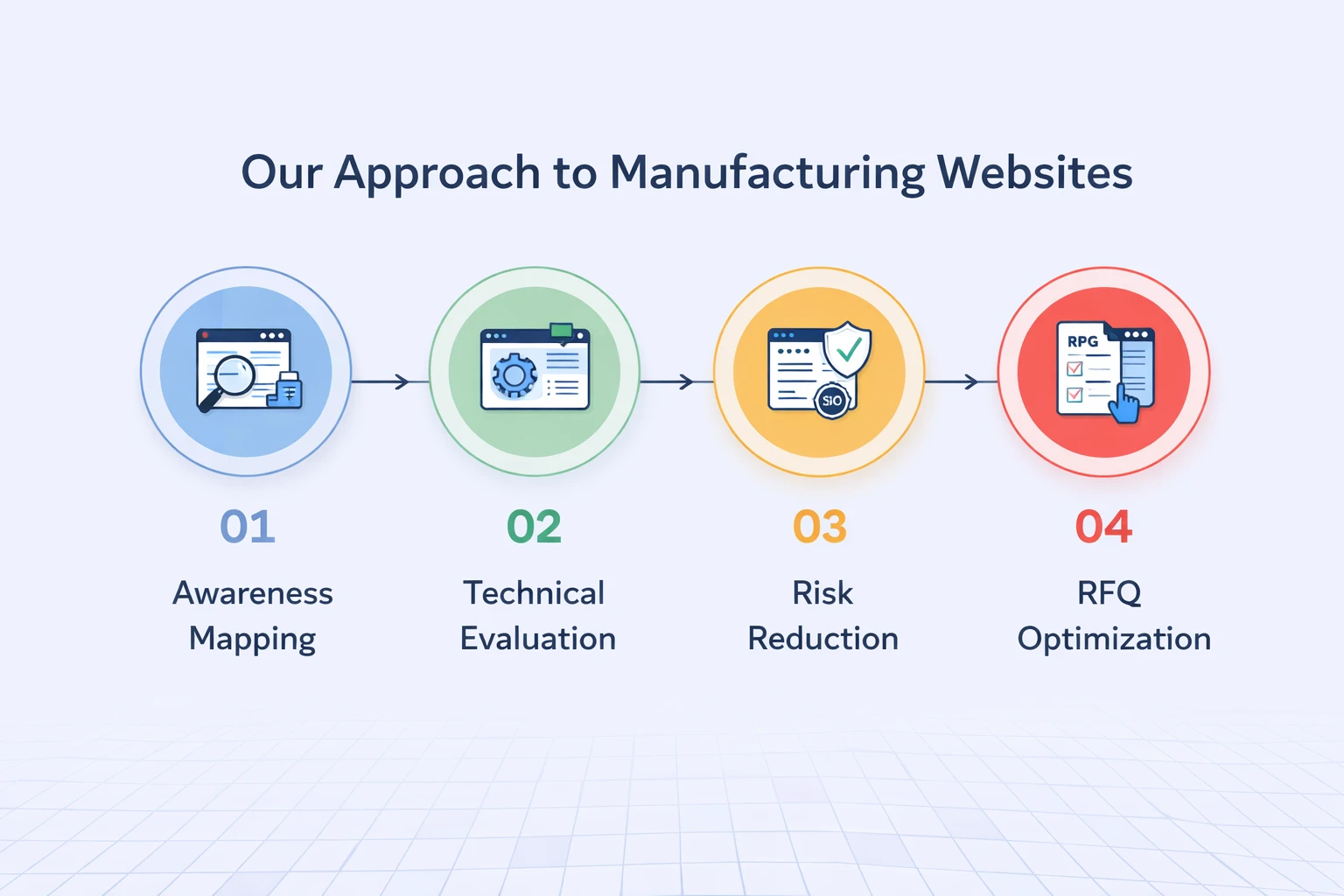
Our Approach to Manufacturing Websites
A manufacturing website is a system — not a design project.
01 01
Awareness
“Do They Even Manufacture What We Need?”
Buyer Questions:
- Do they make this product?
- Do they serve our industry?
- Are they relevant to our scale?
What Your Website Must Show:
- Clear product categories
- Industry-specific pages
- Certifications overview
- Manufacturing capability summary
If your homepage is vague, buyers leave in seconds.
02 02
Evaluation
“Are They Technically Capable?”
This is the stage where serious opportunities are won or lost.
By now, the buyer already knows you exist.
Now they need proof.
Real buyer questions look like this:
- Can they machine EN24 or SS316?
- What tolerances can they hold? ±0.01mm or ±0.05mm?
- What is their monthly production capacity?
- What CNC machines do they operate?
- Do they handle surface treatments in-house?
- What quality checks are performed before dispatch?
- What industries have they supplied before?
If your website forces buyers to call you just to get basic capability information, you create friction. And in B2B manufacturing, friction equals elimination. Your website must function as a pre-qualification system.
That means:
- Detailed product pages
- Clear technical specifications
- Machinery lists
- Process explanations
- Industry pages
- Downloadable datasheets
- Real facility images
When buyers can evaluate you independently, two things happen:
- Only serious enquiries come through
- You enter comparison stage based on capability — not price
This is where most manufacturing websites collapse. They talk about “quality.” Buyers look for numbers.
03 03
Risk Reduction
“Can We Trust Them?”
Now the buyer is comparing vendors.
They want assurance.
Buyer Concerns:
- Will they deliver on time?
- Are they financially stable?
- Do they meet compliance standards?
- Who else trusts them?
Website Requirements:
- Client logos
- Case studies
- Certifications (ISO, etc.)
- Testimonials
- Quality control process
- Company history
Trust is built here. Not with animations. Not with colors.
04 04
Action
“Can They Respond Clearly and Professionally?”
At this point, serious buyers want:
- RFQ submission
- Drawing upload
- Technical discussion
- Sample request
Your contact form should not be:
Name
Message
It should filter and qualify:
- Product required
- Quantity
- Industry
- Timeline
- Drawing upload
- Technical specifications
This reduces low-intent enquiries and improves sales efficiency.
How to Map Your Manufacturing Buyer Journey
| Stage | Buyer Question | Website Content Needed | CTA |
|---|---|---|---|
| Awareness | Do they make this? | Industry + Product pages | View Products |
| Evaluation | Are specs suitable? | Datasheets + Process page | Download Specs |
| Decision | Can we trust them? | Case studies + Certifications | Request Discussion |
| Action | Can they quote fast? | Structured RFQ form | Submit RFQ |
- Homepage clearly states: “Precision CNC Machined Components for Automotive & Industrial Applications”
- Industry pages for Automotive, Heavy Engineering
- Product pages with tolerances, materials, finishes
- Machinery list (5-axis CNC, VMC, etc.)
- ISO certifications
- RFQ form with drawing upload
This becomes your website blueprint. Not a design layout — a sales system.
Quick Example
Imagine a precision CNC components manufacturer. Current homepage: “We Deliver Excellence Worldwide.” No specs. No tolerance levels. No industries served. Now imagine restructuring based on buyer journey:
- Homepage clearly states: “Precision CNC Machined Components for Automotive & Industrial Applications”
- Industry pages for Automotive, Heavy Engineering
- Product pages with tolerances, materials, finishes
- Machinery list (5-axis CNC, VMC, etc.)
- ISO certifications
- RFQ form with drawing upload
Same company. Completely different conversion potential.
Why This Matters for Manufacturing Businesses
If your website does not support the buyer’s evaluation process, three things happen:
- Serious buyers shortlist competitors who show clearer capability
- You receive vague, low-intent enquiries
- Sales conversations start with price instead of value
When buyers cannot assess your production capacity, tolerances, certifications, or industry experience online, they assume one of two things:
When buyers cannot evaluate you online, they assume your competitor is more capable — even if you are not.
- You don’t have it
- Or you are not organized enough to present it
Both damage trust.
And in manufacturing, trust directly impacts order value.
A properly structured website does not just generate leads.
It filters.
It educates.
It pre-qualifies.
It reduces sales cycle friction. It shifts conversation from:
“How cheap are you?”
to
“Can you deliver 5,000 units per month within this tolerance range?”
That is a completely different positioning. And that shift does not happen through design. It happens through buyer-aligned structure.
Is Your Manufacturing Website Built Around Real Buying Decisions?
If your website is only a digital brochure, it is not helping your sales team.
It is just existing online.
If you want a website structured around:
- Supplier evaluation
- Technical clarity
- Trust building
- RFQ conversion
Then it must be designed as a manufacturing sales system — not just a design project.
👉 See how our Manufacturing Website System aligns your website with supplier evaluation and RFQ generation.”
👉 Or request a strategic discussion